
How Business Owners Can File Taxes with Confidence
A Practical 5-Step Overview from Cloud 9 Accounting
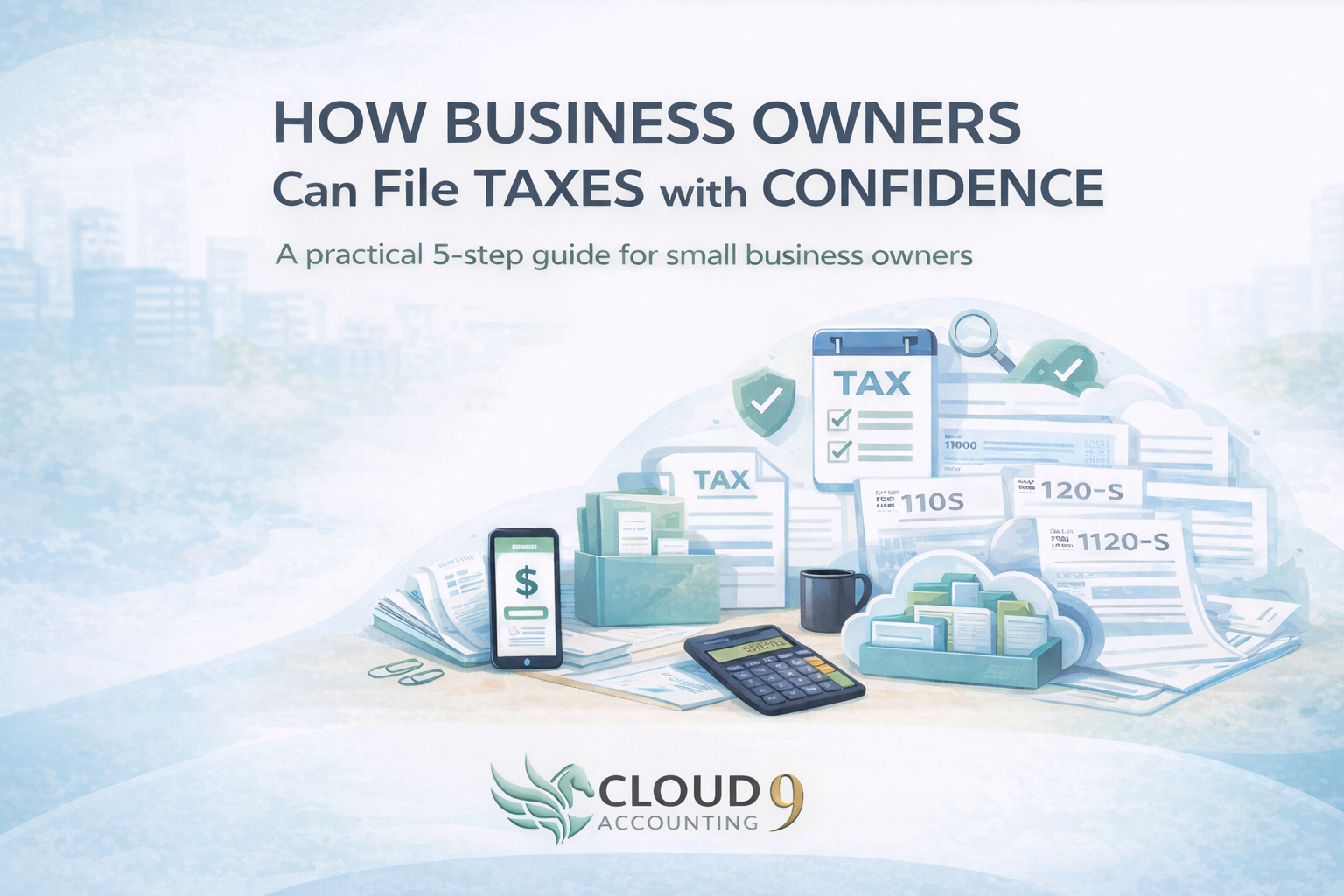
A Practical 5-Step Overview from Cloud 9 Accounting
Filing business taxes does not have to be overwhelming—but it does require preparation, accuracy, and the right systems in place. Each year, we see the same issues delay filings, create unnecessary stress, or lead to costly mistakes for business owners.
The good news: most of these issues are avoidable.
Below is a clear, business-owner-focused framework to help you approach tax filing with confidence.
1. Organize Your Financial Records (Digitally)
Before any tax forms are completed, your financial records must be accurate, complete, and well-documented. This includes:
- Income records
- Expense documentation
- Bank and credit card statements
- Payroll reports
- Prior-year tax filings
Using electronic receipts and secure digital document storage is now a best practice—not just a convenience. Digitally storing receipts, invoices, and statements by year and category helps:
- Support deductions
- Reduce lost or missing documentation
- Simplify audits and tax preparation
- Speed up year-end filing
To make this easier, we recommend using a receipt capture and document storage solution like Spark Receipts to keep everything organized year-round.
Clean books and clean documentation create the foundation for a smooth tax filing process.
2. Identify the Correct Tax Forms for Your Business
One of the most common mistakes business owners make is filing the wrong tax forms. Your filing requirements depend on how your business is structured, not just what you do.
Here is a simple breakdown:
Sole Proprietor or Single-Member LLC (Not taxed as an S corporation)
- File Schedule C with your personal Form 1040
Partnership or Multi-Member LLC
- File Form 1065
- Issue Schedule K-1s to owners
S Corporation
- File Form 1120-S
- Issue Schedule K-1s to shareholders
C Corporation
- File Form 1120
Most businesses also have separate payroll and contractor reporting requirements, which are not part of the income tax return but are just as critical.
Filing the wrong form—or missing a required one—can result in penalties, delays, or IRS notices.
3. File Using Complete and Accurate Data
Tax software and tax forms only work as well as the information entered into them. Incomplete bookkeeping, misclassified expenses, missing receipts, or unsupported deductions often lead to:
- Overpaying taxes
- Delayed refunds
- IRS notices after filing
Accurate books, supported by electronic receipts and proper documentation, significantly reduce risk and improve outcomes.
4. Stay Ahead of Business Tax Deadlines
Missing deadlines is one of the most costly compliance mistakes for business owners. Below are the key federal deadlines to keep on your calendar.
January 31
- W-2s must be issued to employees
- 1099-NEC forms must be issued to contractors
- W-2 and 1099 filings must also be submitted to the IRS
March 15
- S Corporations (Form 1120-S)
- Partnerships (Form 1065)
- Deadline to issue Schedule K-1s (unless extended)
April 15
- Sole Proprietors / Schedule C (Form 1040)
- C Corporations (Form 1120)
- First-quarter estimated tax payment
September 15
- Extended deadline for S Corporations and Partnerships
October 15
- Extended deadline for individual returns, including Schedule C filers
Extensions provide more time to file, not more time to pay—making year-round bookkeeping essential.
5. File Electronically Whenever Possible
Electronic filing improves accuracy, speeds IRS processing, and allows refunds to be issued faster when one is due. It also provides confirmation that your return has been received and accepted, reducing uncertainty and follow-up issues.
Conclusion
The Bottom Line for Business Owners
Tax filing is not just a compliance task—it reflects the quality of your bookkeeping, documentation systems, and year-round tax planning.
Clean books, electronic receipts, and secure document storage lead to:
- Smoother filings
- Fewer surprises
- Better financial decisions
If you are unsure whether your records, receipt storage, or compliance deadlines are truly under control, Cloud 9 Accounting helps business owners get organized before filing season pressure hits.
Latest blog posts

Contact us
Discover how we can simplify your bookkeeping, streamline your accounting, and help you make smarter financial decisions. Reach out today! We’re here to help you save time, reduce stress, and grow your business.